
23 April 2026
Louisa Ghevaert was delighted to attended Progress Educational Trust’s event “What Does the NICE Fertility Guideline Update Mean For You?” on 15 April 2026. This followed the first comprehensive update of the UK’s National Institute for Health and Care Excellence (NICE) Fertility Guideline since 2013. This event looked at a range of issues including whether this will improve access and NHS funding for fertility treatment across England, the new endometriosis fertility pathway, new focus on fertility care at a primary care level, increased focus on male factor fertility and diversity and inclusion (to include transgender and non-binary individuals).
The publication of the long awaited updated NICE Fertility Guideline on 31 March 2026 provides revised guidance on diagnosing and treating health-related fertility problems. Its stated aims are to reduce variation in practice and improve how fertility problems are investigated and managed. However, it is set against a landscape across England where 3 full cycles of NHS funded IVF for qualifying individuals recommended under NICE’s Fertility Guideline 2013 was never fully implemented. PET’s NHS Fertility Funding Tracker’s latest analysis also shows 40 out of 42 Integrated Care Boards (ICBS) remain non-compliant with a majority of these, 29 ICBs, offering only 1 cycle of NHS funded IVF for qualifying individuals.


Image: Sarah Norcross, Director Progress Educational Trust
The publication of the updated NICE Fertility Guideline 2026 also coincides with the UK government’s publication of the updated Women’s Health Strategy for England on 15 April 2026. However, this updated Women’s Health Strategy for England rather disappointingly only provides limited detail about improving support for fertility care:
“Action 22: we will support ICBs to adopt upcoming NICE guidance on fertility problems.
NICE will publish an updated guideline for fertility problems to ensure that advice for clinicians reflects the latest evidence about diagnosing and treating fertility problems. The draft guideline includes updates to extend fertility preservation services (freezing eggs, sperm or embryos) to anyone facing medical treatments or conditions that could harm their fertility. These services should now be available to people of all ages when there is medical need, including young girls and teenagers. We are currently working to assess current provision of NHS-commissioned fertility services as a baseline to inform supporting material for every ICB to implement the new NICE guidelines in full”.
As such, this event asked whether the new updated NICE Fertility Guideline will make a difference in practice?

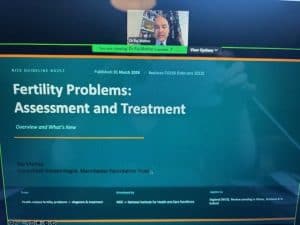
Image: Dr Raj Mathur Consultant Gynaecologist, Subspecialist in Reproductive Medicine and Surgery
Dr Raj Mathur started work with the NICE Fertility Guideline Committee in 2021 to review and update the 2013 Fertility Guideline. He explained that the 2026 NICE Fertility Guideline includes new and updated guidance on:
- Investigation of fertility problems and management strategies.
- Management of ovulation disorders, and tubal and uterine surgery.
- Unexplained fertility problems in people trying to conceive through unprotected vaginal sexual intercourse.
- Endometriosis.
- Access criteria and procedures for IVF treatment.
- Intracytoplasmic sperm injection.
- Fertility preservation for medical indications.
Dr Mathur explained that the updated 2026 NICE Fertility Guideline now provides initial guidance at a primary care level for people who are concerned about delays in conception. This includes lifestyle advice for women about regularity of intercourse, consumption of alcohol, smoking, BMI and folic acid and additionally for men, advice about tight underwear, hazardous occupations, recreational drugs and stress. It also sets out referral thresholds for further clinical assessment and investigation e.g. for women under 36 years after 12 months of regular unprotected sexual intercourse, or after 6 cycles of artificial insemination, or for women aged 36 years or over at presentation. He explained that this clear focus on fertility care at a primary care level is a major change, updating previous guidance which was ambiguous and depended on individual GPs.
Dr Mathur explained that the single largest change in the updated 2026 NICE Fertility Guideline is the increased focus on male factor fertility. This now sets out recommendations for investigation, medical and surgical treatment and ICSI. This now includes semen analysis, genetic testing, medical management and surgery including for azoospermia (zero sperm count) and varicocele (enlargement of veins within the scrotum).
Dr Mathur went on to explain that access to NHS funded IVF has also been updated and the updated 2026 NICE Fertility Guideline now recommends:
- For women under 40 years old that 3 NHS funded IVF cycles are offered (subject to eligibility) and if no conception after 3 cycles, consider offering a further 3 cycles.
- For women aged 40 – 41 years old 1 NHS funded IVF cycle (subject to eligibility).
- Women aged 42 no NHS funded IVF (on the basis it is not cost effective).
Dr Mathur further explained that Intrauterine Insemination (IUI) is now recommended, where previously it was not, to include: for disability/psychosexual indications and donor IUI pathways, as well as 4 IUI cycles for unexplained infertility and endometriosis before IVF treatment.
Dr Mathur explained the updated 2026 NICE Fertility Guideline also includes a new endometriosis fertility pathway. This came about because patients, Endometriosis UK and clinicians called for change during the public consultation. It also recognises that endometriosis can affect multiple organs and that multidisciplinary care is essential. As such, the new endometriosis pathways recommends:
- Personalised assessment, with a clinician taking into account a range of factors including length of time spent trying to conceive, severity of symptoms, age, ovarian reserve and male fertility factors.
- First line options, to include expectant management (time to conceive naturally) or surgical treatment.
- If the above approaches are unsuccessful or inappropriate, discuss fertility treatment options IUI or IVF.
- IVF access (standard IVF access criteria apply).
Finally, Dr Mathur explained that the updated 2026 NICE Fertility Guideline expands its recommendations on fertility preservation to include transgender and non-binary people. Subject to eligibility it covers sperm freezing, egg and embryo freezing, ovarian tissue freezing, ongoing storage and follow up.
Professor Richard Anderson then delivered a further in-depth assessment of the updated 2026 NICE Fertility Guideline. He explained that whilst there are lots of positives, including the fact that it is now inclusive of transgender and non-binary people, there are still issues and missed opportunities.

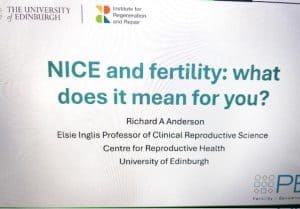
Image: Professor Richard Anderson Professor of Clinical Reproductive Science at the University of Edinburgh
Professor Anderson explained that whilst the 2026 NICE Fertility Guideline recommends improved genetic testing of men’s sperm if concentration is less than 1 million/m, it does not recommend testing for sperm DNA damage. This is because there is no clear pathway to treatment following this sort of test. He further explained that the updated Fertility Guideline continues to state that it is ‘out of scope’ to test women via blood progesterone testing for ovulation if they are experiencing fertility problems due to issues with test results. Instead, women’s AMH levels should be used to predict ovarian response. Additionally, testing for thyroid function should not be undertaken unless there are symptoms and this is ‘out of scope’, although testing for coeliac disease is now included in cases of unexplained infertility.
Professor Anderson went on to explain that NICE is currently developing a guideline on Polycystic Ovary Syndrome (PCOS) and this is expected in December 2026. He also explained that the updated 2026 NICE Fertility Guideline sets out recommendations covering Intrauterine Insemination (IUI) in a licensed clinic to ‘ensure clinical safety and legal parenthood’ including:
- 12 cycles of unstimulated IUI (provided there are no contraindications) before considering IVF for those unable to have vaginal sex or heterosexual couples needing donor insemination.
- For others after 6 cycles of donor insemination IUI then offer 6 cycles of donor insemination IUI.
Professor Anderson also explained that the updated 2026 NICE Fertility Guideline recommendations to offer women under age 40 3 NHS funded IVF cycles and then consider a further 3 IVF cycles could give scope for ICBs to opt out of this, particularly as most are not currently providing 3 NHS funded IVF cycles in any event. In addition, he explained that egg donation remained ‘out of scope’. Moreover, the updated 2026 NICE Fertility Guideline does not offer pre-implantation genetic testing of embryos for aneuploidy (PGT-A) as part of fertility treatment to improve live birth rates.
Anya Sizer then discussed the emotional impact of endometriosis and the new endometriosis pathway under the updated 2026 NICE Fertility Guideline. She explained that endometriosis symptoms include pain, fatigue and fertility challenges. These are often downplayed, but symptoms can be wide-ranging affecting many areas of a woman’s health. Endometriosis is a chronic condition where tissue similar to the uterine lining grows outside the uterus. This can cause gastrointestinal problems, pain, difficulties with sex. It can also impact women’s ability to contribute in the workplace and in society (a social loss).
Anya Sizer explained that the new endometriosis pathway in the updated 2026 NICE Fertility Guideline recommends:
- Primary care recognition.
- Improved referral pathways to specialists.
- Access to diagnostic services.
- Ongoing management and review.
Anya Sizer went on to explain that the updated 2026 NICE Fertility Guideline recommendations include an emotional focus. This includes recognition of the psychological impact of endometriosis, encouragement of holistic person care and integration of mental health support. This involves involving patients in decisions, respecting individual experiences and putting in place tailored treatment plans.

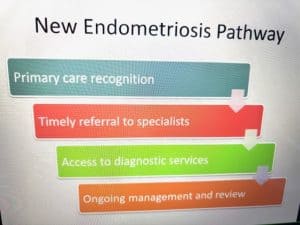
Image: Anya Sizer Trustee The Fertility Alliance
Katie Rollings, Founder & CEO of Fertility Action then provided a male fertility, LGBTQIA+ and inclusion review of the updated 2026 NICE Fertility Guideline. She explained that the updated guidance contains an explicit commitment to inclusion ‘regardless of sexual orientation, partnership status or gender identity’. It now contains gender-inclusive language throughout, for example transgender men, transgender women and non-binary people are referenced by reproductive anatomy.
Katie Rollings explained that the updated 2026 NICE Fertility Guideline recommendations now includes provision of a defined IUI-to-IVF pathway for lesbian women. It also includes important advice on use of unregulated donor sperm and recommends use of licensed fertility clinics over unregulated donor options given legal parenthood and clinical screening risks encountered by lesbian and single women. Furthermore, transgender fertility preservation is now explicitly addressed, recommending egg and sperm freezing for transgender people undergoing gender affirming treatment.
Katie Rollings went on to explain that there are, however, a number of gaps that remain in the updated 2026 NICE Fertility Guideline which mean that ICBs and front-line services are still likely to struggle to translate this into a fair and consistent policy for LGBTQIA+ people. She explained that the updated guidance does not provide advice for earlier investigations of lesbian, transgender or gay people who may have ovulatory, tubal or other medically relevant fertility factors. In addition, there is no standalone pathway for non-medical donor insemination. Furthermore, there is an absence of donor sperm guidance (including phenotype matching, identity-release information). Moreover, reciprocal IVF is not mentioned and there is no pathway to parenthood for gay men or transgender people through egg donation and surrogacy. As a result, she called for a ‘Supplementray LGBTQIA+ Guideline’ produced with NICE, the British Fertility Society, the HFEA, clinicians, patients and community groups.

Image: Katie Rollings Founder & CEO of Fertility Action
Katie Rollings also explained that the updated 2026 NICE Fertility Guideline recommendations contain an explicit recognition of make fertility as a core component of infertility care. As such, there should be routine inclusion of male partners in fertility care assessment pathways, rather than defaulting to female-focused investigation first. This included earlier and more consistent deployment of semen analysis as part of initial investigations to reduce delays in identifying male factor infertility. She explained that there is also clearer guidance on clinical varicocele (enlargement of veins within the scrotum) diagnosis and treatment, including surgery options. In addition, there is expanded use of endocrine and genetic evaluation whereby men with abnormal semen results should be offered hormonal profiling and genetic testing to identify underlying causes. Furthermore, there are defined pathways for surgical sperm retrieval for men with azoospermia (zero sperm count) as well as fertility lifestyle advice for men. Moreover, there is improved access to sperm freezing for men undergoing medical treatment affecting fertility (e.g. cancer treatment, testosterone use) and prolonged repeated IUI or expectant management should be avoided.
To conclude, Katie Rollings explained that whilst male fertility is better recognised in the updated 2026 NICE Fertility Guideline, there is no requirement for men’s fertility to be assessed at the same pace as women’s fertility nor a structured pathway to support men preconception. In addition, whilst varicocele is recognised further clarity is required around timing of intervention and surgery. Moreover, there is no clear national pathway for specialist andrology access or dedicated male fertility services.
The Value of Fertility & Family Law Expertise, Advisory & Consultancy
Ongoing fertility challenges (as set out above), later-life parenthood and complex legal and regulatory frameworks make it important to consider legal as well as medical issues to maximise individual fertility and pathways to parenthood. Specialist fertility and family law strategies, advisory and consultancy helps inform effective approaches to (in)fertility and optimise reproductive health outcomes, as well as proactively manage family building arrangements. They identify and address a range of legal and practical issues across the family building and reproductive life cycle from preconception, through pregnancy, birth, family life and end-of-life, including:
- Family building options and legal issues due to impaired fertility including cancer diagnosis, unsuccessful conception, miscarriage, age-related fertility decline, genetic disorders, change in gender, delayed parenthood.
- Complex personal and family situations.
- Legal and practical aspects of fertility preservation.
- Navigating fertility treatment law in the UK.
- DNA and genetic testing and the law.
- Legal and practical aspects of assisted conception with an intra-family donor, known donor, anonymous/identity-release donor, co-parent or ex-partner (e.g. legal parentage, parental rights, financial responsibility and dispute mitigation).
- 3-person IVF and the law.
- Legal and wider aspects of international surrogacy or a UK surrogacy arrangement.
- Import or export of genetically matched gametes and embryos.
- Posthumous conception law and genetic legacy.
- Expert witness fertility, donor conception and surrogacy law services.
- Care and upbringing of children and complex family law issues and disputes.